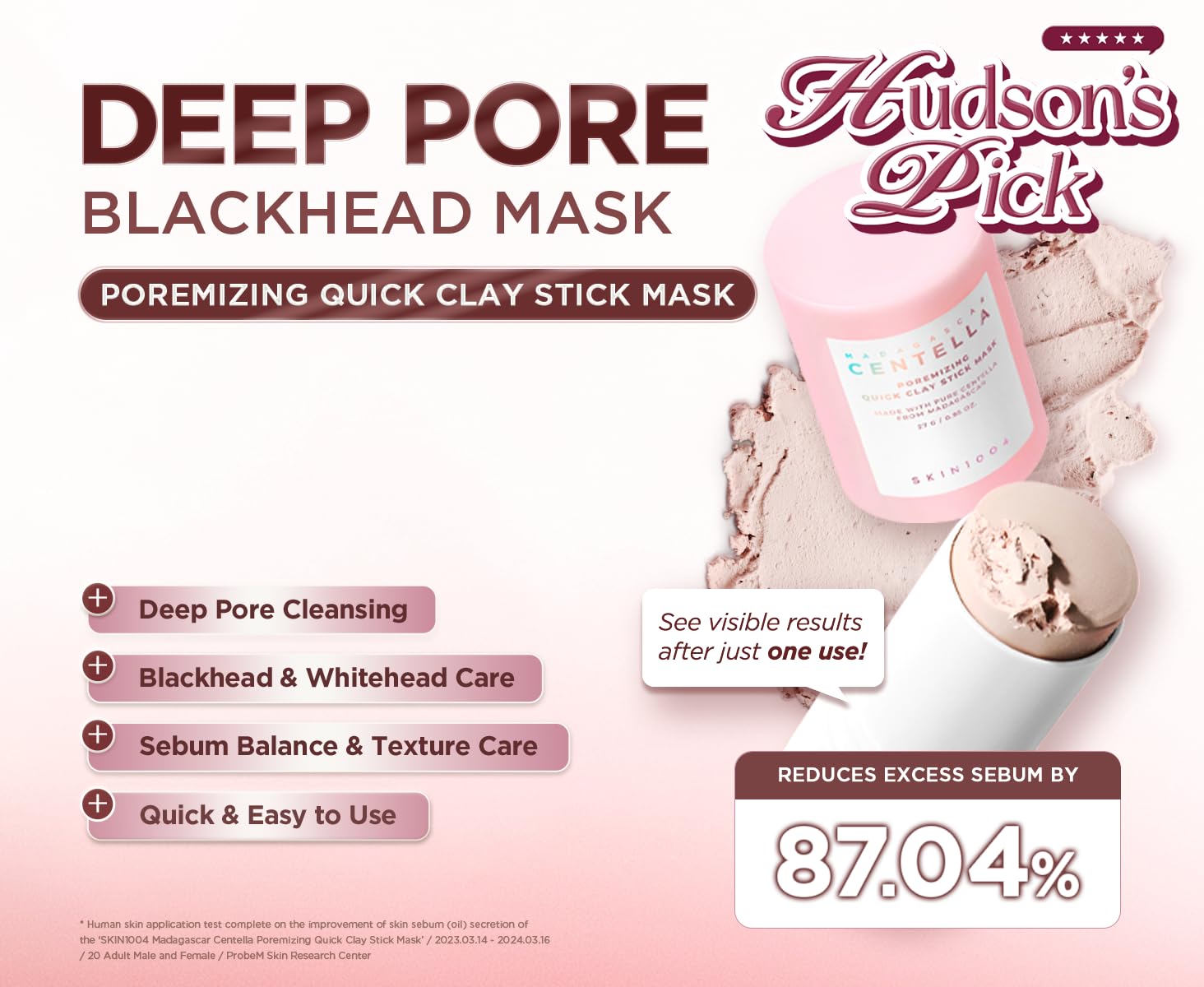
If you’ve ever felt like a clay mask left your skin squeaky-clean but somehow worse — tight, irritated, more congested two days later — you’ve already encountered the core tension in pore care. A clay mask is a product that uses naturally absorbent minerals (most often kaolin, bentonite, or a regional equivalent) to pull excess oil and surface debris out of pores. “Pores” are simply the tiny openings where hair follicles and oil glands meet the skin’s surface; they look enlarged when they’re stretched by sebum (the skin’s natural oil) and oxidized debris. Western formulas have historically treated this as a problem to be solved aggressively — the harder the suck, the better the result. Korean beauty (K-beauty) largely disagrees with that logic. This guide breaks down why the philosophies diverge, what’s actually happening at the ingredient level, and how to use that framework to make a smarter buying decision whether you’re stocking a treatment room or refining your own at-home protocol.
The Formulation Philosophy Gap: Absorption vs. Stripping
The difference between most Western and K-beauty clay masks isn’t the clay itself — both traditions use kaolin and sometimes bentonite. The difference is in what surrounds the clay.
Classic Western pore masks — think the perennially popular Aztec Secret Indian Healing Clay (essentially 100% calcium bentonite, $10) or Freeman Feeling Beautiful Charcoal + Black Sugar Mud Mask ($5) — are built on a “more is more” theory of sebum control. Maximum clay concentration, minimal buffer ingredients, sometimes an acidic activator like apple cider vinegar mixed in. The logic: pull as much oil out as fast as possible. Paula’s Choice Expert Advice notes that while bentonite is an effective absorbent, using high-concentration clay without humectant balance can compromise the skin barrier (the outermost protective layer of skin cells and lipids that keeps moisture in and irritants out). When you strip the barrier repeatedly, sebaceous glands — the oil-producing structures — often compensate by producing more sebum, not less. Reviewers across aggregated sources consistently flag this rebound pattern after several weeks of heavy bentonite use on oily skin.
K-beauty formulas generally position clay as one instrument in a multi-layer arrangement rather than the whole orchestra. Across INCIDecoder ingredient analyses of bestselling Korean masks, the pattern is: a modest clay base (typically kaolin, sometimes volcanic ash or white clay) combined with ferments, centella asiatica extract, niacinamide, or hyaluronic acid — ingredients designed to calm and hydrate while the clay absorbs. The result is a mask that works more slowly on any single application but trains skin toward balance rather than triggering a defensive rebound.
The Ingredients Making the Difference
Understanding a few key actives makes it much easier to evaluate label claims rather than relying on marketing language alone.
Kaolin vs. Bentonite — same family, different personalities. Kaolin (also called China clay or white clay) has a finer particle structure and a gentler absorption rate than bentonite. Healthline’s overview of kaolin notes it’s generally considered suitable for sensitive and dry-combination skin types because it absorbs excess oil without drawing moisture from the deeper skin layers. Bentonite is more electrically charged and therefore more aggressively absorbent — powerful for truly oily skin, but riskier for daily or frequent use. Most K-beauty formulas favor kaolin; Western “deep pore” formulas frequently lean on bentonite for that dramatic tightening sensation.
Volcanic ash — the K-beauty differentiator. Several Korean brands source volcanic ash (sometimes listed as volcanic clusters or jeju volcanic ash) from Jeju Island, a volcanic island off the southern coast of South Korea. Cosmetics & Toiletries has published on clay mineral interactions with sebum, and volcanic ash minerals share properties with kaolin but carry a micro-porous texture that reviewers consistently describe as “polishing” rather than “pulling.” The effect on pores is gentler and more mechanical — loosening oxidized debris rather than force-drawing oil.
Fermented ingredients and the skin barrier. Fermentation is a cornerstone of K-beauty formulation. Fermented rice water, fermented black bean extract, and similar ingredients appear frequently in pore-targeted Korean masks. The fermentation process breaks down larger molecules into forms skin can absorb more readily, and byproducts like lactic acid provide mild chemical exfoliation (loosening dead skin cells that clog pores) without the irritation risk of higher-concentration AHA serums. Per Byrdie’s ongoing coverage of K-beauty ingredients, fermented actives are consistently credited by reviewers for improving skin texture without the post-mask dryness that follows single-ingredient clay applications.
Niacinamide — the sebum regulator, not just a brightener. In Western skincare, niacinamide (a form of vitamin B3) is most commonly discussed as a brightening agent. In K-beauty pore masks, it earns its place as a sebum regulator. Allure’s reporting on clay masks notes that niacinamide at concentrations of 2–5% has demonstrated effects on reducing sebum excretion rates in clinical research, meaning it targets one root cause of visible pores rather than just masking the symptom.
By the Numbers
| Clay Type | Absorption Intensity | Typical K-Beauty Use | Typical Western Use |
|---|---|---|---|
| Kaolin | Gentle | Primary base in most K-beauty masks | Secondary or blended |
| Bentonite | Aggressive | Rare; occasionally blended | Primary in “deep pore” formulas |
| Volcanic Ash (Jeju) | Moderate, mechanical | Differentiator ingredient; Jeju-sourced brands | Uncommon |
| French Green Clay | Moderate | Occasional in hybrid formulas | Mid-tier prestige staples |
Evaluating K-Beauty Pore Masks Across Price Tiers
The K-beauty market in 2026 spans genuine budget entry points through legitimate prestige positioning, and price does not track linearly with efficacy. Here’s the decision framework that matters.
Entry tier (~$8–$18): Brands like Innisfree (Volcanic Pore Clay Mask, ~$15) and some Clean & Clear K-beauty crossover lines sit here. Innisfree’s volcanic mask is one of the most-reviewed K-beauty clay masks in global markets; reviewers on aggregated sources consistently describe it as effective for blackhead loosening with minimal post-mask dryness — a meaningful distinction from comparable-priced Western alternatives. At this price point, expect kaolin or volcanic ash as the primary clay, simpler humectant support, and limited fermented actives. Good for: establishing whether the K-beauty approach suits your skin before spending more.
Mid tier (~$25–$55): This is where formulation complexity earns its premium. Sulwhasoo Clarifying Mask ($48) incorporates traditional Korean herbal medicine (hanbang) extracts alongside kaolin; reviewers at Byrdie consistently flag the texture and absorption balance as qualitatively different from entry-tier options. COSRX Full Fit Propolis Honey Overnight Mask ($27) is not a classic clay mask but represents the K-beauty hybrid approach — propolis (a resin produced by bees) as an antimicrobial and barrier-supporting ingredient alongside light pore-clearing agents. If you’re stocking a treatment room, mid-tier K-beauty masks are worth evaluating for clients whose skin responds poorly to Western clay protocols; the lower strip-rate reduces post-treatment redness flags.
Prestige tier (~$60–$120+): The 111SKIN Celestial Black Diamond Lifting Mask (~$185) occupies a category of its own — it is not a traditional K-beauty formula but a London-developed prestige hybrid with Korean formulation influence and luxury positioning. Closer to true K-beauty prestige, Sulwhasoo’s full mask collection and some OSEA Malibu crossover lines occupy the $58–$90 range. At this investment, the cost-per-use math requires attention: a 3.5 oz prestige mask used twice weekly at a single-layer application delivers approximately 30–40 applications per jar, putting per-use cost between $1.50 and $4.50. That math favors the prestige option if the formulation reduces the need for additional serums, toners, or pore treatments — which K-beauty layering logic is specifically designed to do.
Decision Rules: If X, Then Y
The practitioner’s version of this question is rarely “which mask is best overall” — it’s “which mask fits this specific situation.” Here’s the explicit decision frame:
If your skin or your client’s skin rebounds with increased oiliness after bentonite-heavy Western masks: Shift to kaolin-primary K-beauty formulas. The rebound pattern is a sebaceous compensation response, and gentler absorption breaks the cycle. Start with an entry-tier Jeju volcanic mask to confirm the response before investing in mid-tier.
If you’re addressing blackheads specifically (not just general oiliness): Prioritize masks with both kaolin and a mild chemical exfoliant — fermented lactic acid or low-percentage BHA (salicylic acid). The mechanical action of volcanic ash loosens oxidized debris; the chemical exfoliant helps clear the follicle opening. Per Paula’s Choice Expert Advice on pore minimization, consistent gentle exfoliation over 6–8 weeks produces more visible pore-size reduction than any single aggressive treatment session.
If you’re sourcing for a treatment room and need to minimize adverse reaction risk: K-beauty hybrid masks with fermented humectants and low clay concentrations are defensively safer for mixed skin type clientele than high-bentonite Western options. The tradeoff: clients accustomed to the “tight and clean” sensation of Western masks may initially perceive K-beauty formulas as less effective. Set expectations at intake.
If you are at the prestige tier and evaluating whether the upgrade is justified: The honest question is whether you are currently using multiple products to compensate for a single-function clay mask (a separate hydrating toner post-mask, a pore serum, a barrier repair cream). If yes, a prestige K-beauty mask that integrates humectants, ferments, and a sebum regulator may reduce the overall protocol cost even at a higher per-jar price. Run the math on your full pore-care routine, not just the mask line item.
If you’re a newcomer to K-beauty and skeptical of the “gentler = better” claim: The skepticism is fair. Cosmetics & Toiletries research on sebum regulation notes that absorption rate alone is not the primary driver of long-term pore appearance — barrier integrity and sebum production rate are. A gentle mask used consistently outperforms an aggressive mask used less frequently because irritation-avoidance improves compliance. Give a kaolin-based K-beauty formula a true 6-week comparison window before drawing conclusions.
The bottom line: K-beauty clay masks are not a compromise on pore care — they’re a different theory of it. The Western approach optimizes for single-session visible impact; the K-beauty approach optimizes for the sebum environment over time. Neither is universally superior, but if the aggressive-strip protocol isn’t delivering stable results, the K-beauty model offers a well-formulated alternative with a clear ingredient rationale behind it. Compare the full pore-care lineup at SkinMud’s mask comparison tool, or browse the top-rated K-beauty options by skin type to find your starting point.