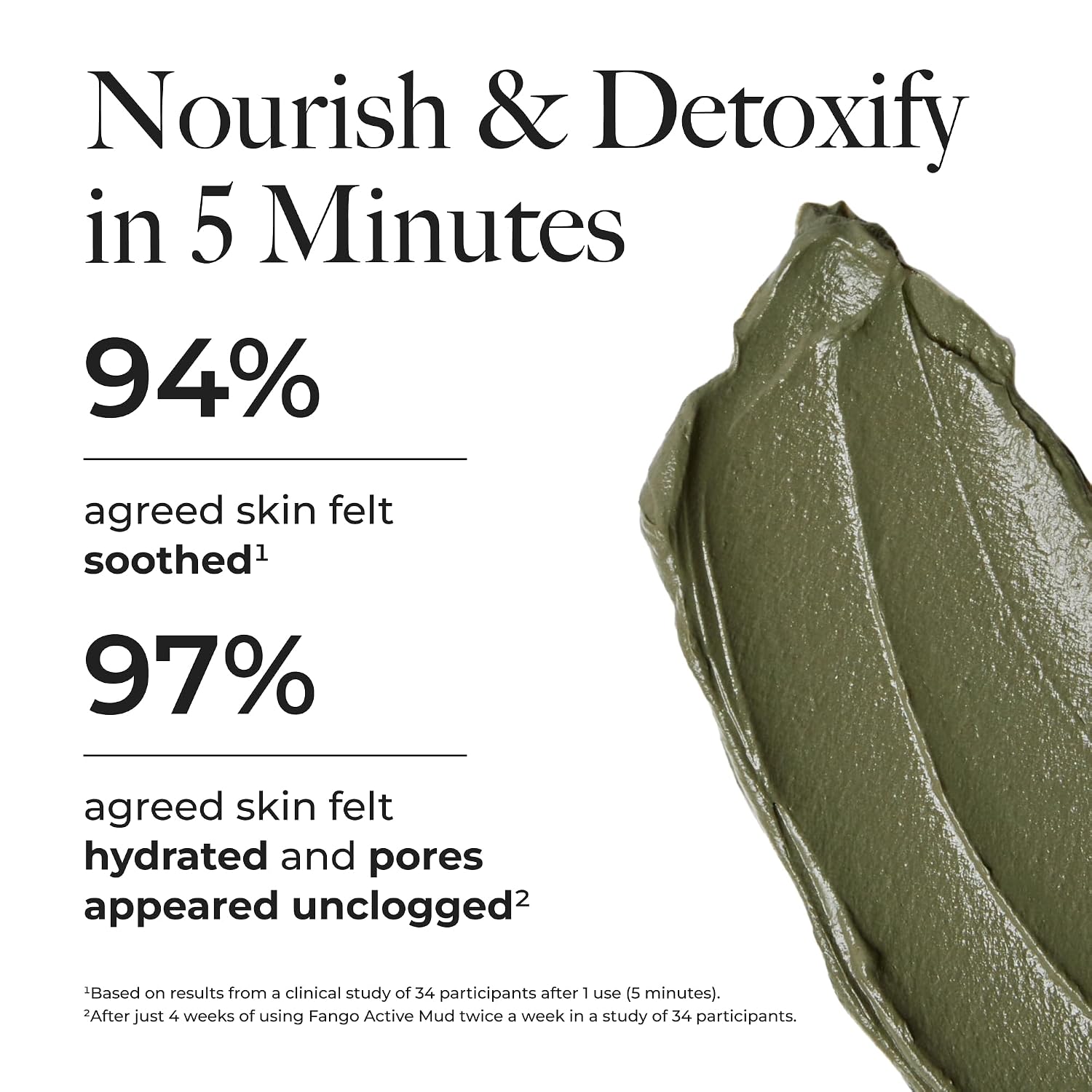
Borghese Fango mud masks have been a prestige-counter fixture since the brand launched in the 1950s, and their signature ingredient — fango, which is simply the Italian word for mud — comes from the volcanic thermal springs of Montecatini Terme in Tuscany. Thermal mud (mud that forms when mineral-rich geothermal water saturates volcanic earth over decades) is prized in professional skincare because it carries a denser mineral load than air-dried clays mined from riverbanks or quarries. If you’ve ever seen a spa menu charge $80 for a “volcanic mud treatment,” this is the category that price point is anchoring to. This article is a structured buying decision: what you’re actually getting with Borghese Fango, how the two main retail sizes change the value calculation, and whether the provenance story holds up when you compare it to what you’d spend on functionally similar prestige alternatives.
By the time you finish reading, you’ll have a clear if/then decision rule — whether this is your next jar, a professional-treatment staple, or an elegant splurge you can confidently skip.
What “Thermal Volcanic Mud” Actually Means for Skin Performance
The marketing language around Borghese leans hard on geography — and for once, the geography matters. Per Cosmetics & Toiletries’ overview of mineral-rich clays in cosmetic formulation, thermally processed volcanic muds differ from kaolin or bentonite clays in one meaningful way: they carry a higher concentration of trace minerals (magnesium, calcium, sulfur, silica) that survive into the finished product because the mud is never fully dried and reconstituted. It arrives as a paste rather than a powder. That distinction is relevant to how the mask behaves on skin.
Healthline’s overview of mud mask benefits notes that the primary mechanism for all clay and mud masks is the same — adsorption (the process by which a substance draws oils and impurities to its surface the way a magnet attracts metal, rather than absorbing them like a sponge soaks up liquid). Where thermal muds gain an edge, according to formulators cited in dermatology literature, is in their secondary mineral action: the trace ions may support barrier function mildly after the mask is removed, rather than leaving skin feeling stripped the way high-kaolin formulas sometimes do.
Paula’s Choice Expert Advice section on clay and mud mask use reinforces this with practical guidance: sulfur-rich volcanic muds tend to be better tolerated by redness-prone and combination skin than pure bentonite, which can tip toward over-drying if left on too long. This is worth noting because Borghese recommends a 5–7 minute application — shorter than the 10–15 minutes many bentonite users are accustomed to. That’s not a weakness; it’s the mask’s formulation telling you something about its concentration.
The EWG Skin Deep Database entries for Borghese Fango Active Mud rate the formulation at a 3 (moderate) on their hazard scale — driven primarily by fragrance components, not the mineral base — which is comparable to most mid-to-prestige clay masks currently on the market.
The Two Sizes: How the Math Actually Shifts
Borghese sells Fango Active Mud in two primary retail formats — a 2.7 oz (about 76g) jar and a 7 oz (about 198g) jar. These aren’t just size variations; they represent meaningfully different value propositions depending on your use case.
By the numbers (May 2026 retail pricing):
| Size | Approximate Retail | Per-Ounce Cost | Estimated Applications* |
|---|---|---|---|
| 2.7 oz | ~$42–$48 | ~$16–$18/oz | 8–12 uses |
| 7 oz | ~$68–$75 | ~$10–$11/oz | 22–28 uses |
*Based on a standard 1/4 teaspoon thin-layer application to face and neck; spa-style fuller coverage reduces count.
The cost-per-use math here is unusually favorable on the larger jar — roughly a 35–40% reduction in per-application cost, which is a bigger spread than you see with most prestige skincare where large-format SKUs typically save 15–20%. For a home user masking once or twice per week, the 7 oz jar is approximately a six-month supply. For an esthetician or treatment-room buyer doing full-face applications on clients, the 7 oz jar covers roughly 20–25 professional applications — and at that volume, the per-use cost drops below $3, which sits well inside professional treatment margins.
The 2.7 oz jar makes sense in two scenarios: you’re trialing Borghese before committing to the large format, or you travel frequently and want a TSA-compliant size that doubles as a shelf-worthy product in a hotel kit.
Prestige Price Justification: Comparing Against the Category
This is where most Borghese articles get vague, so let’s be direct. The relevant comparison tier is prestige specialty mud masks in the $50–$90 range for a full-size jar. The main competitors in that range that reviewers consistently bring into the same conversation include:
OSEA Malibu Mud Mask (~$58 / 2.5 oz): Sourced from Patagonian seaweed and Pacific mineral mud, positioned more toward hydration than purification. Reviewers at Byrdie consistently rate it for dry-to-normal skin types, whereas Borghese skews oilier and more congestion-focused.
Eminence Organics Stone Crop Masque (~$62 / 2 oz): Certified organic, plant-forward formulation. The stone crop botanical is the active, not clay. Different mechanism, similar price. Eminence is generally the better choice for sensitized post-treatment skin; Borghese is the better choice for active congestion.
GlamGlow Supermud (~$69 / 1.2 oz): The smallest jar at the highest per-ounce cost. Reviewers at Allure consistently cite its multi-acid plus clay formula as more aggressive — effective for spot treatment and stubborn pore congestion, but less suitable for full-face use on reactive skin.
Origins Clear Improvement Active Charcoal Mask (~$30 / 3.4 oz): The honest entry-level comparison. For buyers asking whether Borghese justifies its premium over Origins, the answer is conditional: owners of both consistently report that Borghese leaves skin feeling less tight post-use, and the mineral residue rinses cleaner. But Origins is nearly half the price for a larger jar. If your skin doesn’t react poorly to higher-kaolin formulas, the upgrade case for Borghese isn’t slam-dunk for home use.
Where Borghese wins clearly: the professional treatment context. Reviewers and estheticians on professional skincare forums consistently flag Borghese Fango as one of the few retail-accessible masks that reads credibly as a treatment-grade product to clients — the texture, the scent, the Montecatini sourcing narrative, and the visible mineral content all support a $15–$25 add-on upsell in a facial service. OSEA and Origins don’t carry the same weight in that context.
Skin-Type Suitability and Frequency Guidance
Based on aggregated owner reviews and the Paula’s Choice Expert Advice guidance on frequency for thermal mud formulas:
- Oily / combination / congestion-prone: 1–2 times per week. This is Borghese’s primary intended audience, and reviewers consistently describe meaningful pore-clarity results within 2–3 weeks of regular use.
- Normal / dry: Once per week maximum, and follow immediately with a hydrating serum or moisturizer. The sulfur content that benefits oilier skin can tip toward dryness on already-balanced complexions.
- Sensitive / redness-prone (rosacea-adjacent): Proceed cautiously. Healthline’s overview of mud mask precautions flags sulfur-containing formulas as potentially irritating for reactive skin types despite sulfur’s anti-inflammatory reputation. Patch test on the inner arm for 24 hours first.
- Post-procedure / compromised barrier: Skip entirely until barrier is fully restored. No mud mask — regardless of price or mineral sourcing — is appropriate on a disrupted skin barrier.
The 5–7 minute application window Borghese recommends is worth taking seriously. Owners who extended to 15–20 minutes (following bentonite-mask habits) more frequently reported tightness and mild flaking, which is over-masking. The formulation is doing its work quickly because the mineral concentration is higher than drugstore clays.
The Decision Framework: If X, Then Y
If you’re a home user currently on Origins Clear Improvement or Aztec Secret: The upgrade to Borghese’s 2.7 oz jar is a reasonable one-jar trial at roughly $42–$48. You’ll notice the difference in post-rinse feel within two or three uses. If your skin is combination-to-oily and you use clay masks twice a week, the 7 oz jar is the better value commitment once you’ve confirmed the formula works for you.
If you’re an esthetician or spa buyer adding a mud treatment to your menu: The 7 oz jar at ~$68–$75 is a straightforward margin calculation — 20+ applications at a $15–$25 treatment add-on gives you a 4x–7x return on product cost, which is well inside standard treatment-room economics. The provenance story is narratable to clients in a 30-second explanation: Italian thermal springs, volcanic mineral mud, used in European spas since the mid-20th century. That story lands in a treatment room in a way that a drugstore clay mask cannot.
If your skin is dry, sensitive, or post-procedure: Neither size of Borghese Fango is the right call right now. Route toward OSEA Malibu Mud Mask or Eminence Stone Crop Masque, which are formulated around hydration and calm rather than purification.
If you’re evaluating Borghese against the $100+ prestige tier (111SKIN, Premier Dead Sea, Ahava professional collections): Borghese sits below that tier on mineral concentration and formulation complexity, but it’s also $50–$150 less expensive. It is not a compromise pick — it’s a different product at a different price point. If your decision is “Borghese or nothing in the $70 range,” the 7 oz jar is an easy yes for the right skin type. If your decision is “Borghese or 111SKIN Celestial Black Diamond at $185,” that’s a different category entirely and the Borghese is not attempting to compete there.
The honest summary: Borghese Fango earns its prestige price through genuine provenance, a thermal mud base that performs differently than reconstituted clays, and a cost-per-use math that gets genuinely competitive at the 7 oz size. It’s not the most innovative formula at its price point, but it’s one of the most consistent — and in professional skincare, consistency is underrated.
Ready to compare Borghese Fango side by side with OSEA, GlamGlow, and Origins in a single view? Head to our [mud mask comparison tool] to filter by skin type, price per ounce, and ingredient origin — and find which jar actually belongs on your shelf.