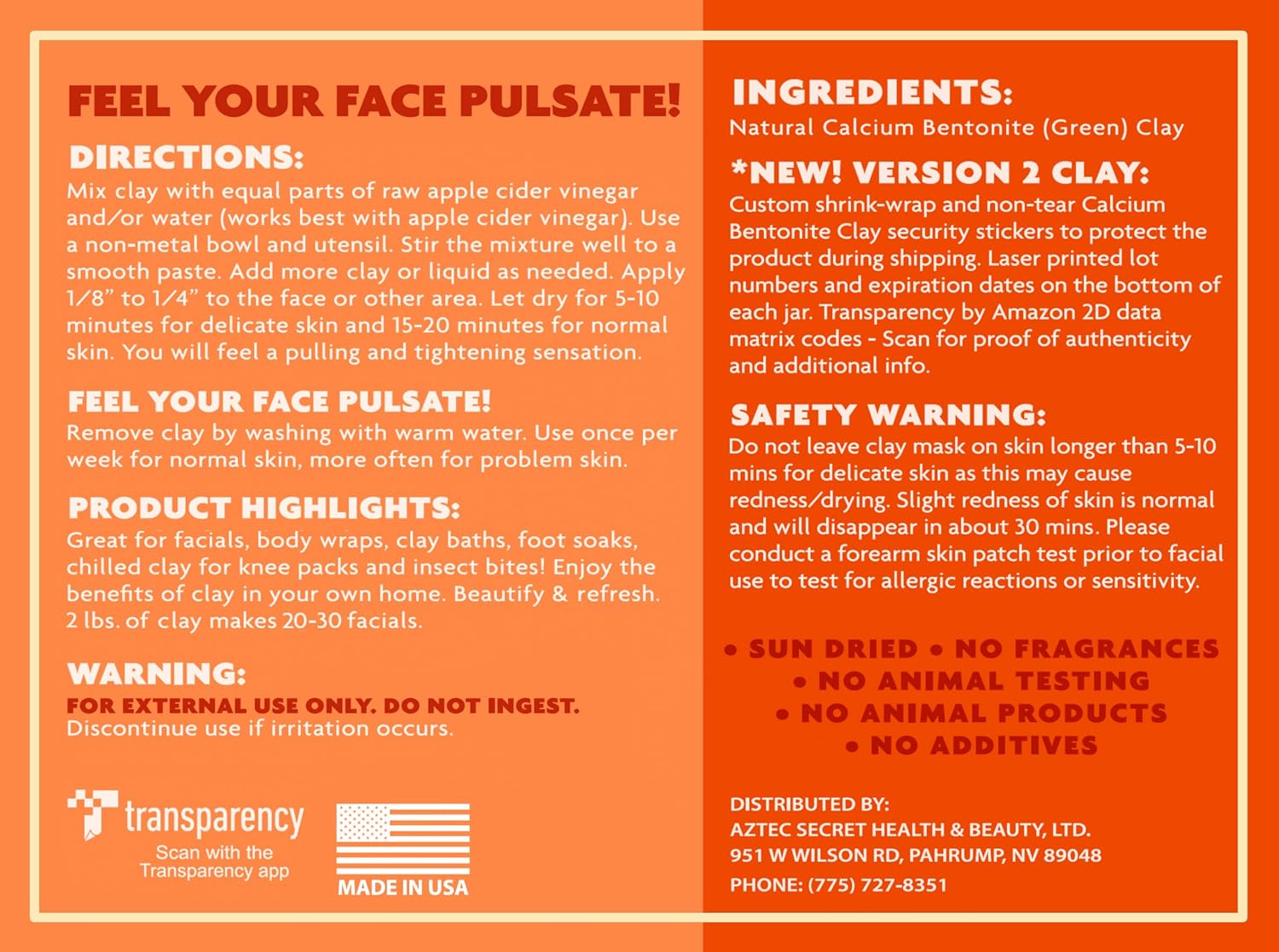
If you have ever stood in a drugstore aisle looking at a modest white jar labeled Aztec Secret Indian Healing Clay and wondered what the fuss is about, here is the short version: it is pure calcium bentonite clay — a naturally occurring mineral material mined from volcanic ash deposits, most famously in Death Valley, California. Bentonite clay (ben-TO-nite) carries a negative electrical charge that, when activated with liquid, draws positively charged impurities — excess oil, debris, environmental residue — toward the clay like a magnet. You mix a small amount of the dry powder with either water or apple cider vinegar, apply it to your face for 5–15 minutes, and rinse. That is the whole ritual. What makes Aztec Secret worth talking about in a buying-guide context is not novelty; it is the cost-per-use question. The product ships in at least three sizes — 1 lb, 2 lb, and 5 lb — and the price gap between them is not linear. If you are purchasing for personal use, a treatment room, or resale, buying the wrong size quietly inflates your per-application cost. This guide runs the math and tells you exactly where the value break lives.
The Math First: Cost-Per-Use Across Every Jar Size
Let’s establish the numbers before we layer in the decision variables. Retail prices fluctuate, but as of mid-2026 the following figures reflect widely observed selling prices across major online retailers.
Aztec Secret Indian Healing Clay — Cost-Per-Use Snapshot
| Size | Approx. Retail Price | Yield per Full-Face Use (approx. 1–2 tbsp / 7–14 g) | Est. Uses per Jar | Cost Per Use |
|---|---|---|---|---|
| 1 lb (454 g) | ~$10–$12 | ~10 g | ~45 uses | ~$0.22–$0.27 |
| 2 lb (908 g) | ~$17–$20 | ~10 g | ~90 uses | ~$0.19–$0.22 |
| 5 lb (2,268 g) | ~$33–$38 | ~10 g | ~225 uses | ~$0.15–$0.17 |
Yield estimate based on a standard single-application mix: approximately 1 tablespoon of dry powder (~7–10 g) for one full-face treatment, consistent with manufacturer guidance and usage notes aggregated across Byrdie and Allure’s clay mask coverage.
The 5 lb jar is, purely on math, the cheapest path. But cost-per-use math only wins if you actually use the product before it degrades — and bentonite clay has a real shelf-life consideration that most buyers underestimate.
The Shelf-Life Variable Nobody Talks About
Dry bentonite clay is shelf-stable for years if stored correctly — sealed, away from moisture and humidity. That sounds forgiving until you consider what “away from moisture” means in a bathroom environment, where most people keep their skincare. As Healthline’s overview of bentonite clay notes, the mineral’s absorptive capacity is its defining feature; that same capacity means the powder will begin pulling ambient moisture if the lid is not resealed tightly after every use. Once clay starts clumping from humidity exposure, it has partially “spent” some of its absorptive capacity.
The practical implication: a solo user going through one full-face application per week (the frequency Paula’s Choice Expert Advice recommends as a ceiling for oily-to-combination skin — more on that shortly) would consume roughly 45 uses from a 1 lb jar in under a year. A 5 lb jar at that same cadence represents nearly five years of product. For a single user storing that jar in a humid bathroom, the back half of the 5 lb jar is a gamble.
Who actually beats the degradation clock on a 5 lb jar?
- Estheticians and treatment room operators using it across multiple clients weekly
- Households with 2–3 active users
- Anyone adding body applications (back, décolleté, neck) alongside face
- Buyers who add the powder to DIY mask blends (mixed with kaolin, activated charcoal, or botanical powders) and therefore burn through volume faster
For solo personal use with face-only application, the 2 lb jar is frequently where the math and the reality intersect best.
Frequency Guidance: The Hidden Cost Multiplier
Before committing to any size, the frequency question deserves a straight answer — because over-masking with a highly absorbent clay is one of the more common ways enthusiasts accidentally compromise their skin barrier (the outermost protective layer of skin, which keeps moisture in and irritants out).
Paula’s Choice Expert Advice draws a clear distinction by skin type: oily and combination skin can tolerate one to two clay mask sessions per week; normal-to-dry skin typically does better at once per week or less; sensitive or barrier-compromised skin should treat clay masks as an occasional-use tool, roughly once every two weeks. EWG’s Skin Deep ingredient profile for calcium bentonite notes the ingredient’s high absorption profile and flags that extended or over-frequent contact can transiently disrupt surface lipids.
This matters for the size decision because it directly sets your realistic consumption rate:
- Oily / combination, 2x/week: ~1 lb jar lasts ~5–6 months. 2 lb jar is a comfortable annual supply.
- Normal / combination, 1x/week: ~1 lb jar lasts ~10–11 months. 2 lb jar stretches to nearly two years solo.
- Dry / sensitive, 1x/2 weeks: ~1 lb jar easily covers 18+ months. Larger sizes risk degradation before use.
Allure’s clay mask coverage consistently reinforces the “less is more” principle for everyday users — particularly for anyone with dry patches or visible sensitivity, where the pull of bentonite can feel tight or irritating if applied too frequently.
The Practitioner and Multi-User Decision Frame
If you are sourcing for a treatment room or purchasing for household use across multiple people, the calculus flips meaningfully. Estheticians and spa professionals reviewing large-format clay products on Byrdie and in professional skincare forums consistently name two considerations: per-unit cost and sanitation protocol. Because you are scooping from a shared container, a dedicated clean spatula (never fingers) is non-negotiable — contaminating the powder with skin contact or residual moisture accelerates both microbial risk and the humidity degradation discussed above.
Under those conditions — clean-scooping, resealable storage in a low-humidity environment, and consumption rates of 5–10 uses per week across clients — the 5 lb jar is straightforwardly the right call. The cost-per-use advantage (~$0.15–$0.17 versus ~$0.22–$0.27 for the 1 lb) translates to real dollar savings at volume. Over 225 uses, the spread between the 1 lb price-per-use and the 5 lb price-per-use represents roughly $18–$25 in captured savings — not transformative on a single jar, but meaningful if you are restocking quarterly.
For the professional buyer evaluating Aztec Secret against branded treatment-room clays at 10–30x the price point, the value proposition is not subtle. Byrdie’s roundups and reviewer aggregates note that Aztec Secret’s swelling index — the measure of how much a bentonite expands in liquid, which correlates with its pore-clearing intensity — is competitive with far pricier formulations. The tradeoff is presentation: you are mixing powder yourself rather than opening a finished mask, which adds one step to the treatment workflow.
What the Size Decision Does NOT Solve
There are a few variables the size optimization cannot fix, and a practitioner-level buyer should name them honestly before clicking purchase.
Mixing medium matters more than jar size. The product is inert until activated. Apple cider vinegar produces a more aggressive, lower-pH mix that reviewers on Byrdie and Allure describe as noticeably more “intense” — visible pulsing sensation on the skin, faster tightening. Plain water produces a gentler, higher-pH application that suits sensitive skin and body use better. Neither option is wrong; they are different tools. Your jar size does not change this variable, but your use case should inform which you reach for.
This is a single-ingredient powder, not a formulated mask. For clients or personal use where you want humectants (moisture-drawing ingredients), botanical actives, or skin-calming additions built into the formula, Aztec Secret requires you to add them. Eminence Organics Stone Crop Masque ($62) and OSEA Malibu Mud Mask ($58) address this by building hydrating and botanical layers into their finished formulas. The cost-per-use on those products is higher — but they are not the same product category. The comparison only matters if you are choosing between DIY-blend clay and a finished prestige mask; for pure bentonite clay value, Aztec Secret has essentially no peer at its price tier.
Mixing hygiene is a professional-grade responsibility. EWG’s ingredient data and general cosmetic formulation guidance both note that preservative-free powder masks carry no preservation burden in dry form — but the moment you add liquid, the clock starts. Mixed clay should be used immediately and never stored between applications. For a treatment room, this means mixing fresh for each client, which is straightforward but requires a workflow adjustment if you are transitioning from pre-formulated tube or jar masks.
The Decision Rule
Here is the if/then frame, stated plainly:
-
If you are a solo user with oily-to-combination skin masking once or twice a week: the 2 lb jar is the sweet spot. It is roughly 40–45% cheaper per use than the 1 lb, and at your consumption rate you will finish it in 12–18 months without degradation risk.
-
If you are a solo user with dry, sensitive, or normal skin masking once a week or less: buy the 1 lb jar. At a low cadence, the 2 lb jar will outlast its practical storage window in a bathroom environment, and the cost-per-use premium on the 1 lb is modest.
-
If you are a treatment room operator or household of 3+ users: the 5 lb jar is the call. Clean storage protocol is required, but the per-use cost is the lowest available and the volume is appropriate for the consumption rate.
-
If you have never used bentonite clay before: start with the 1 lb regardless of price math. The 1 lb jar yields roughly 45 uses — far more than enough to establish whether this product and mixing ritual fits your skin and your routine before committing to bulk volume.
The cost-per-use math on Aztec Secret rewards volume — but only when volume matches actual usage. The jar that wins is the one you finish.
Ready to compare Aztec Secret against other clay and mud mask options at every price tier? Use the SkinMud comparison tool to stack formulations side by side — ingredient depth, cost-per-use, and skin-type fit — and find your next jar with confidence.